

Author: Michael Faraday | Technical Director at ZEEHOO, with deep expertise and extensive experience in wireless charging technology.
Table of Contents
1. Semi-Solid-State Battery Technology Actually Makes a Difference
2. Qi2 Wireless Charging Is Finally Fast Enough
3. It Charges Three Devices at the Same Time
4. Pass-Through Charging Solves the One-Outlet Problem
5. Trickle Charging Fixes the AirPods Problem Nobody Talks About
6. Every Hardware Detail Was Thought Through
7. Why It Replaced Slim's Old Travel Power Bank
We're excited to share this hands-on review from YouTuber SlimothyTV!
If you've ever spent time in an airport, on a long road trip, or just away from a wall outlet for too long, you know the feeling. Your phone sits at 12%, there's no charging port anywhere, and that brick-shaped power bank at the bottom of your bag takes forever to give you any real juice.
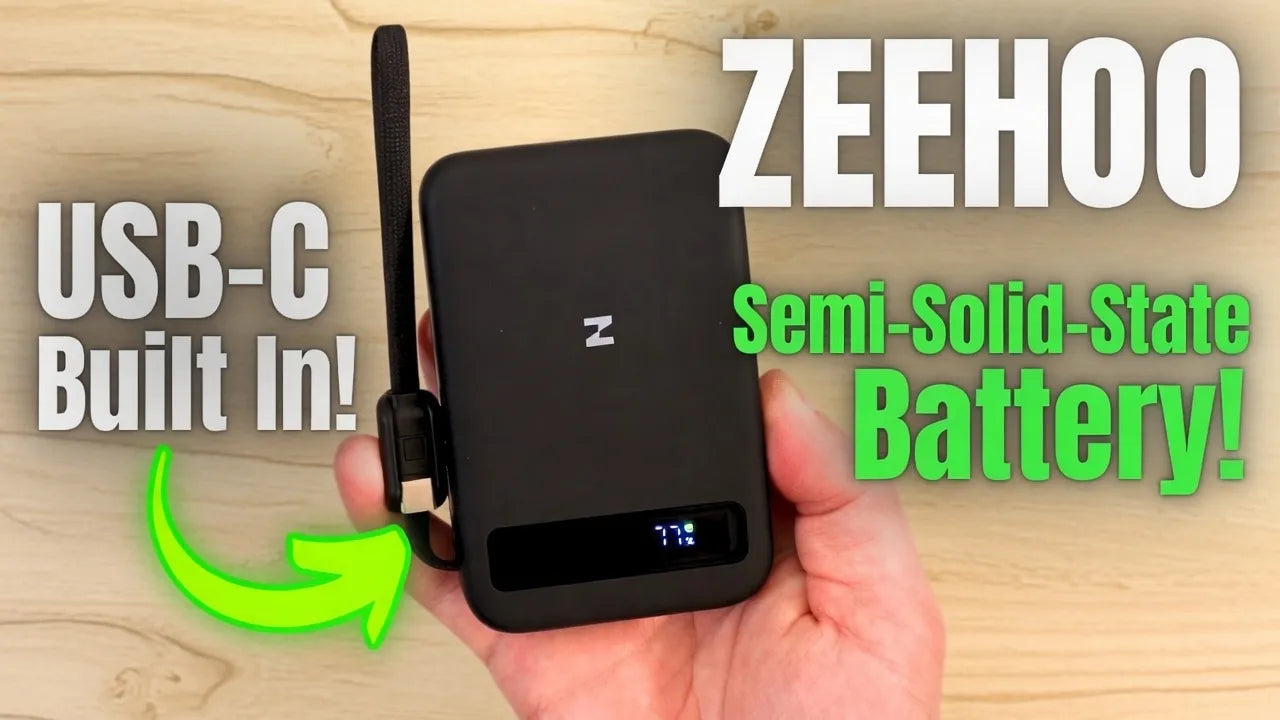
Slim from SlimothyTV reviews a lot of power banks. Like, a lot. So when he says the ZEEHOO MagAir 10,000mAh Semi-Solid-State power bank is going straight into his travel rotation, replacing a unit he's been using for a long time, that's not something to brush off lightly.
What makes this one different? It comes down to a combination of newer battery technology, thoughtful hardware design, and the kind of small details that only matter once you've actually used a power bank long enough to notice what's missing from other ones.

Semi-Solid-State Battery Technology Actually Makes a Difference
Let's start with the thing that separates the MagAir from the vast majority of power banks on the market right now: the battery itself.
Most portable chargers use traditional lithium-ion or lithium-polymer cells. They work fine, but they come with well-known trade-offs. They degrade over time, they heat up under load, and packing more capacity into a smaller body usually means compromising on safety or thickness.
The MagAir uses what's called a semi-solid-state battery cell. If you've been following EV battery news, you've probably heard the term. But for power banks, it's still pretty new. Slim breaks down the three main differences in plain language.

More charge cycles. The battery lasts longer before you notice capacity loss. You're not going to be replacing this thing in six months because it's already holding 60% of what it used to.
Less heat. Semi-solid-state cells run cooler, especially during fast charging. Anyone who's had a power bank get uncomfortably warm in their pocket knows why this matters.
Better energy density. More charge packed into a smaller physical package. That's why a 10,000mAh unit can stay this compact and still feel solid in hand.

You don't need to be a battery engineer to appreciate the difference. You'll just notice that the thing holds up better over months of daily use, stays cooler when you're pushing it hard, and doesn't take up as much pocket space as older tech with the same capacity.
Qi2 Wireless Charging Is Finally Fast Enough
Here's where a lot of MagSafe power banks still fall short. The magnetic wireless charging is convenient, sure, but the actual charging speed is often painfully slow. You snap it on the back of your phone, come back an hour later, and you've gained maybe 15%.
The MagAir is Qi2 certified and pushes 25W of magnetic wireless charging. That's a real-world difference, especially if you have a newer iPhone that supports the higher wattage. Slim notes that snapping it on the back of his iPhone starts charging immediately. No fiddling, no alignment issues, just a clean magnetic connection.

And if you want to go wired instead, which Slim says he does when he's in an airport and needs a quick top-up, the USB-C port delivers 45W of output. That's fast enough to meaningfully charge a phone in the time you're waiting at a gate.
It Charges Three Devices at the Same Time
This is the part of the video where things get genuinely surprising.
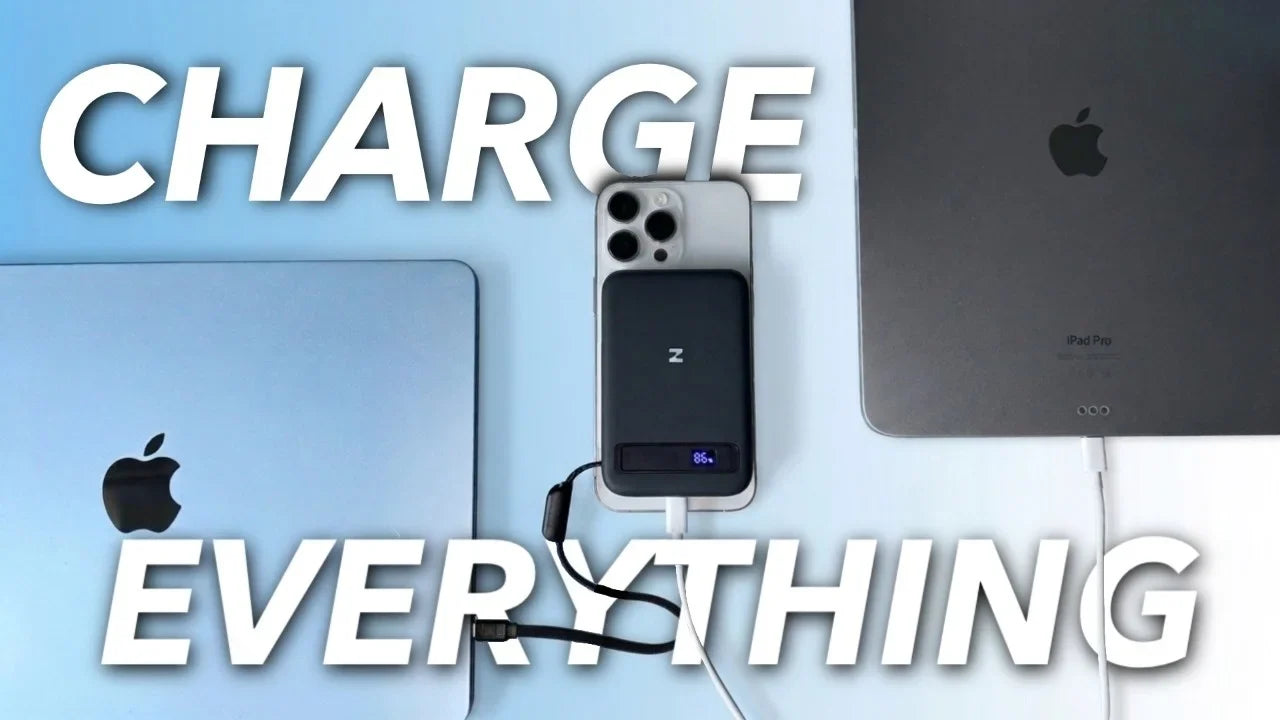
Slim starts by charging one iPhone wirelessly via the magnetic back. Normal so far. Then he grabs a second iPhone and plugs it into the USB-C port. Both are charging. Then, just to see what happens, he plugs in a third phone, an Android, through the other port.
All three devices are charging at the same time. From one 10,000mAh power bank.

Now, you're obviously not going to get full-speed charging on all three simultaneously. That's not how power distribution works. But the fact that it handles three devices without shutting down or overheating is more than most people expect from something this size.
Pass-Through Charging Solves the One-Outlet Problem
This is one of those features that sounds boring until you're in a hotel room with one free outlet and three devices that need power.
Pass-through charging means the power bank can charge itself while simultaneously charging devices connected to it. So you plug the power bank into the wall, snap your phone on the back, plug your AirPods into the USB-C port, and everything charges overnight from a single outlet.
Slim tests this on camera. The power bank is plugged in to charge, one phone is charging wirelessly, and another is charging via USB-C. Everything works. The screen flashes to confirm it's handling input and output at the same time.
If you travel, especially internationally where adapter plugs are limited, this alone could be the reason to pick this over another power bank.

Trickle Charging Fixes the AirPods Problem Nobody Talks About
This is the part of the review that Slim specifically calls out as something other reviewers miss.
If you've ever tried to charge wireless earbuds, like AirPods, with a standard power bank, you've probably run into this. The power bank starts charging them, then shuts off after about 30 seconds because the earbuds draw so little current that the power bank thinks nothing is connected.
It's frustrating, and most people just assume their earbuds are broken or incompatible.
The MagAir handles this correctly. It has low-current charging support, which means it recognizes that you're charging something with a small battery, earbuds, a smartwatch, a fitness tracker, and keeps the power flowing instead of shutting off.
Slim makes a point of saying this doesn't get talked about enough, and he's right. If you carry earbuds and a watch alongside your phone, which is most people, this is a feature that actually matters in daily use, not just on a spec sheet.

Every Hardware Detail Was Thought Through
The hardware design is where the MagAir shows that someone actually thought about how people use these things.
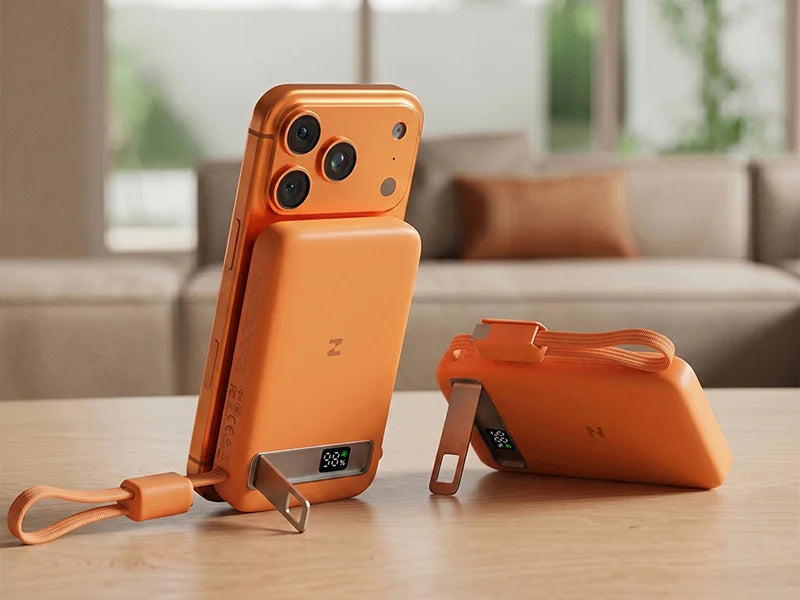
Built-in kickstand. Works in both portrait and landscape. Slim tests both orientations on camera and confirms they hold steady. If you're FaceTiming someone or watching a video on a plane, this is genuinely useful. You're not trying to prop your phone against a bottle of water.

Integrated lanyard that doubles as a USB-C cable. This is clever. The lanyard you'd use to hang the power bank from a bag or wrist is actually a functional charging cable. It clicks into a slot on the body and stays firmly in place. You always have a cable with you, and it's not a separate thing to forget in a hotel room.

Bright digital display. The screen shows battery percentage clearly. Slim mentions that some power banks come with dim, hard-to-read screens. This one isn't like that. You can actually see it without squinting.

Soft-touch finish with minimal branding. It looks clean. The ZEEHOO logo is subtle, the Qi2 25W marking is there but not loud about it, and the material feels good in hand rather than plasticky.
Why It Replaced Slim's Old Travel Power Bank
Slim is upfront about the fact that he had a different 10,000mAh MagSafe power bank that he'd been using as his go-to travel charger. It had the same core features: magnetic charging, a built-in cable, similar capacity.
So why switch?
His answer comes down to the combination. The MagAir doesn't just do one thing better. It does all of them well in one package. He lists it out near the end of the video.
- Pass-through charging. Check.
- Trickle charging for earbuds and small accessories. Check.
- Three devices at once. Check.
- Fast wireless (25W) and fast wired (45W). Check.
- Built-in lanyard that's also a cable. Check.
- Kickstand. Check.
- Bright screen. Check.
- Extra USB-C cable included. Check.
As he puts it: "this has literally everything that I want."
And the context that matters here: Slim tests power banks daily in his studio. He's not a guy who buys one charger every two years and calls it good. The fact that this specific unit replaced his daily driver carries weight.

The Real Test Is How It Holds Up Over Time
One thing worth noting that Slim mentions early in the video: he plans to keep using the MagAir long-term to see how it holds up.
That's the real test for semi-solid-state technology. The immediate benefits, cooler running, snappy charging, compact size, are noticeable right away. But the longer-term advantage, the one that actually justifies the technology shift, is that the battery should degrade more slowly over hundreds of charge cycles.
Most lithium-ion power banks start showing noticeable capacity loss after 300 to 500 cycles. Semi-solid-state cells are expected to hold up better over that same period. Whether that bears out in real-world use over a year of daily charging, that's what long-term testing will show.
But even if you set that aside, the MagAir already earns its place on the strength of what it does today: it charges fast, charges everything, and doesn't make you carry extra cables.

Final Thoughts
The ZEEHOO MagAir isn't trying to win on a single flashy spec. It wins by being the power bank that solves the actual annoyances people deal with. The earbuds that won't charge. The single hotel outlet. The cable you forgot. The dim screen you can't read. The slow wireless charging that barely moves the needle.
If you're looking for one power bank to handle travel, daily use, and everything in between, without carrying a separate cable, stand, or adapter, the MagAir is built for exactly that.
Slim plans to keep using it long-term, and we'll be watching for the follow-up. But based on this hands-on, it's easy to see why it went straight into his travel bag.


Leave a comment
This site is protected by hCaptcha and the hCaptcha Privacy Policy and Terms of Service apply.